
HDPE Black
A bimodal HDPE jacketing compound with 2.5% carbon black — the pigment loading that gives a buried or aerial cable decades of ultraviolet protection rather than a few summers.
At a glance
| Category | Cable Compounds |
|---|---|
| Material type | Bimodal high-density polyethylene jacketing compound, carbon black pigmented |
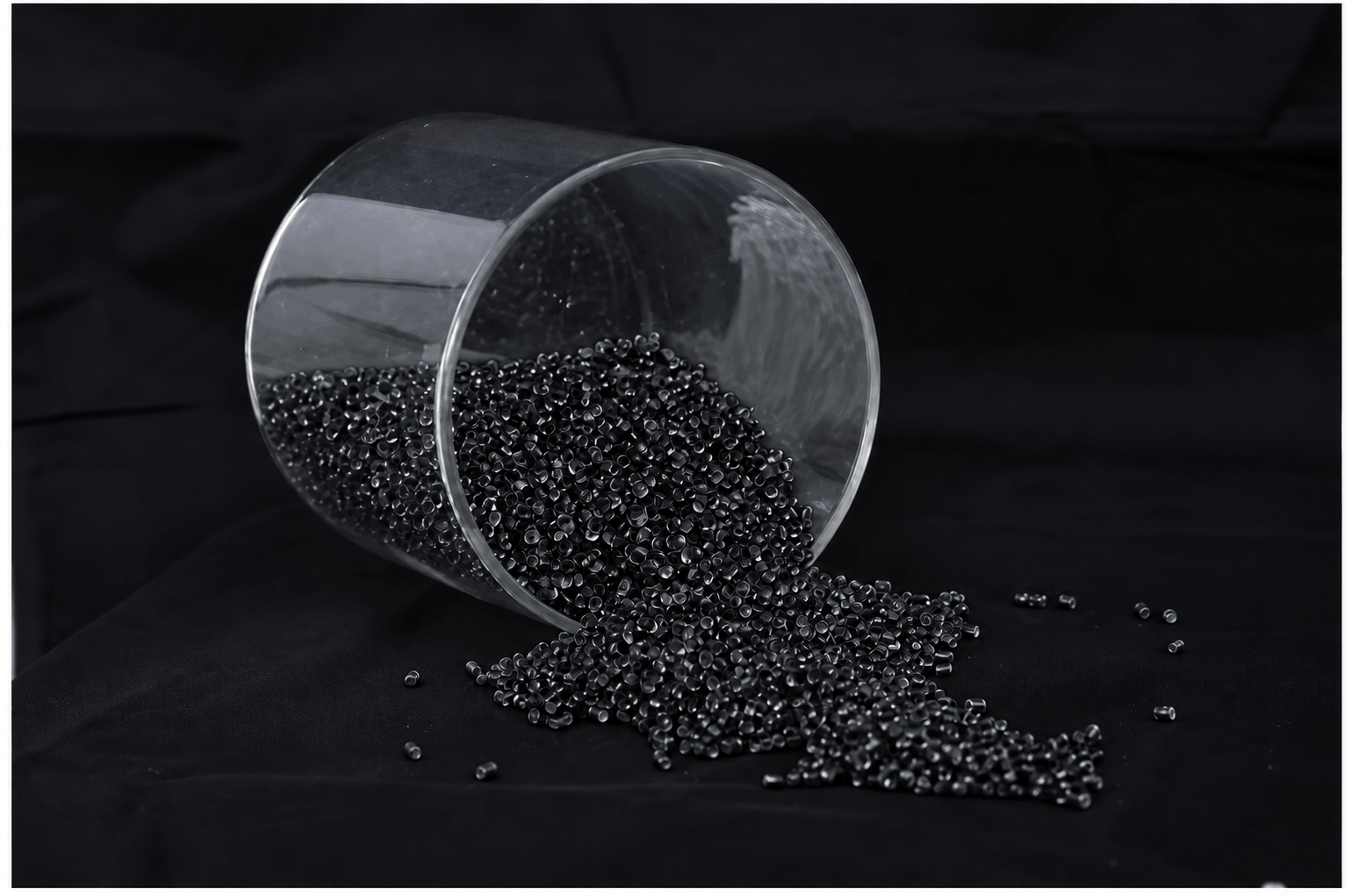
| Appearance | Black pellets, glossy surface finish |
| Carbon black content | 2.5% ± 0.3% (typical) |
| Carbon black type | Furnace black, well dispersed for UV protection |
| Density | Typically 0.950–0.960 g/cm³ |
| Application | Outer jacketing for buried and aerial power, control and telecommunication cable |
| Relevant standards | Commonly specified against IEC 60502 and EN 50290 series jacketing requirements |
| Packaging | 25 kg bags, 1,000 kg big bags |
| Documentation | TDS and SDS on request |
| Supplied from | Istanbul, Türkiye |
Need this material?
Tell us the application, the specification and the volume you work with. Our team will come back with availability and the documentation you need.
Description
What HDPE black jacketing compound is for
This is the outer protective layer of a cable rather than any part of its electrical function. Its job is mechanical and environmental: to resist abrasion during pulling, to keep water out of the cable core, and to survive years of ultraviolet exposure without cracking. High-density polyethylene is used because it is stiffer, harder and more abrasion-resistant than LLDPE, and because its low water permeability suits buried and duct installation.
Why the carbon black figure matters so much
Unprotected polyethylene exposed to sunlight degrades within a season or two: UV breaks the chains, and the jacket becomes chalky and then cracks. Carbon black absorbs ultraviolet before it reaches the polymer, and it is the most effective UV stabiliser available for polyethylene — but only at an adequate loading and with proper dispersion.
Around 2.5% is the industry-standard figure for outdoor cable, and it is not arbitrary. Below roughly 2%, protection falls off quickly. Above 3%, the additional protection is marginal while mechanical properties and processability begin to suffer. Dispersion matters as much as loading: agglomerated carbon black leaves unprotected polymer between the particles and also creates stress concentration points that become crack initiation sites.
What bimodal means here
A bimodal HDPE has a molecular weight distribution with two populations rather than one. The high molecular weight fraction provides environmental stress cracking resistance and toughness; the low molecular weight fraction provides processability. A unimodal resin has to compromise between the two, whereas a bimodal grade delivers both — which is why bimodal resins became the standard for demanding jacketing and pipe applications.
In practice this shows up as a jacket that extrudes smoothly at commercial line speeds yet resists environmental stress cracking in service, a failure mode that matters particularly where a cable is bent around a tight radius and then left in a wet, warm environment for years.
Surface finish
A glossy, smooth jacket surface is not only cosmetic. It reduces friction during duct pulling, which matters on long runs, and it gives fewer surface irregularities where water and dirt can lodge. It also makes printing and embossing of cable identification cleaner and more durable.
Processing and storage
Extrude on standard polyethylene jacketing equipment. Melt temperature and line speed should be set to achieve full melting and good carbon black distribution without overheating; excessive shear in a poorly matched screw can degrade the polymer and show as surface roughness. Store bags dry and sealed, away from direct sunlight, and condition material to workshop temperature before extrusion to avoid moisture condensing on cold pellets.
Frequently asked questions
Why is 2.5% the standard carbon black loading for cable jacketing?
Does carbon black dispersion matter as much as the loading?
What is the advantage of a bimodal HDPE for jacketing?
When should HDPE be chosen over LLDPE for a jacket?
Request documentation or a sample
Technical data sheets, safety data sheets and samples are provided on request. Describe your application and we will recommend the closest matching grade.